Partial payments, cash discounts, and batch payments: keeping open items accurate
Handle partial payments, cash discounts, and batch payments without hiding the remaining balance or closing open items too early.
Quick answer
Handle partial payments, cash discounts, and batch payments without hiding the remaining balance or closing open items too early.
Key takeaways
- A partial payment settles only the confirmed amount.
- A cash discount is not a generic rounding difference.
- When one bank transaction covers several invoices, every allocation needs its own amount.
A difference is not automatically an error
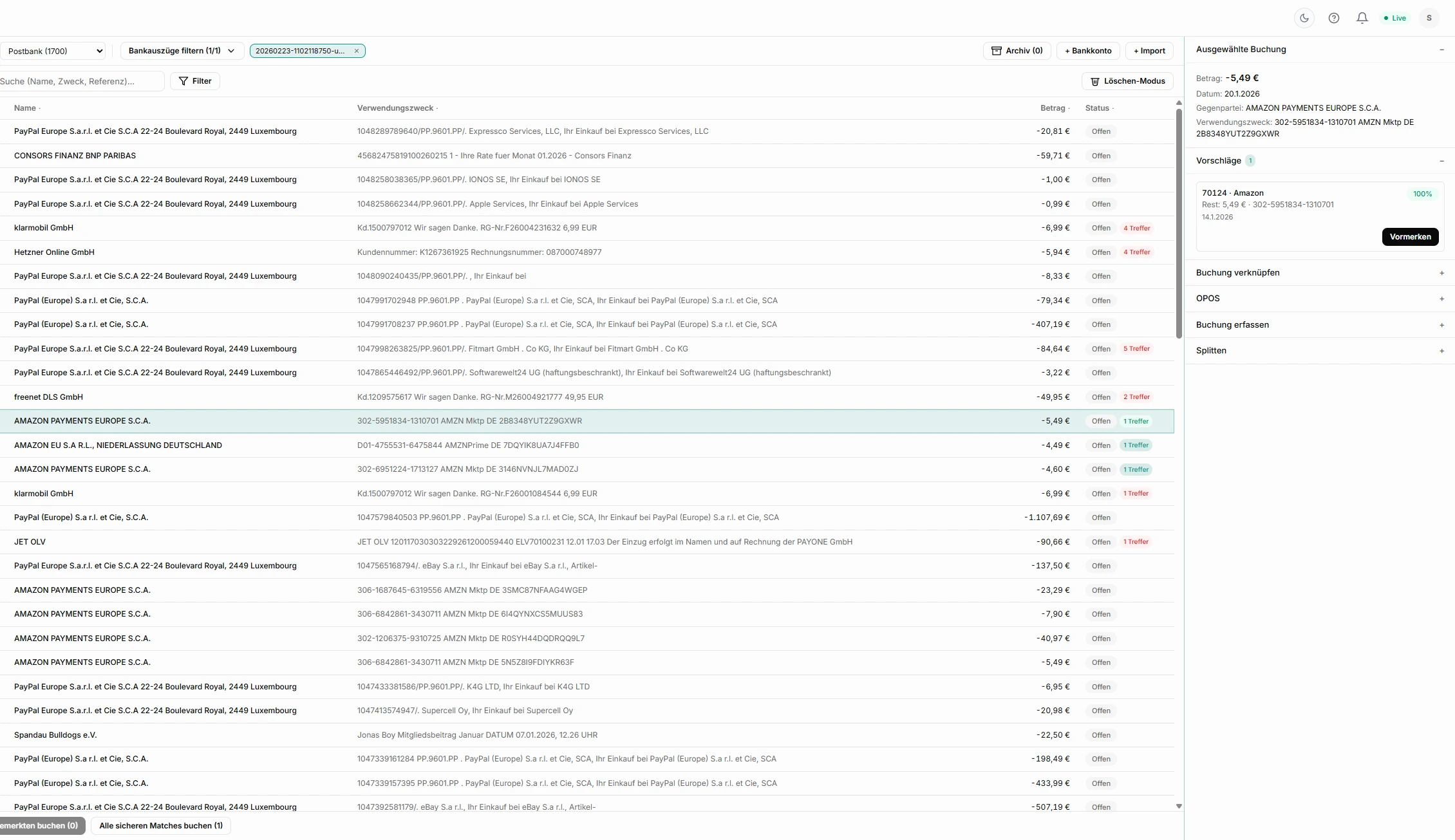
A payment of EUR 5,300 against an invoice of EUR 5,800 is not a complete settlement. The gap may be a partial payment, cash discount, fee, credit, or an unresolved remainder. Matching can rank a plausible invoice, but it must keep the assigned amount and remaining balance visible.
Keep the original open item alive
A partial payment settles only the confirmed amount. The remainder stays linked to the same invoice, due date, and counterparty and can be matched again later. Show the original invoice amount, all prior assignments, the current remainder, and the bank transaction behind every assignment.
Make cash discounts an explicit decision
A cash discount is not a generic rounding difference. Check the agreement, payment deadline, and affected amount before classifying the remainder. Software can calculate and display the difference, but should not infer the accounting decision from amount similarity alone.
Split batch payments transparently
When one bank transaction covers several invoices, every allocation needs its own amount. The total must not silently exceed the transaction, and any unassigned remainder must remain visible. At close, review unresolved bank differences, invoice remainders, and discounts together so bank, open items, and ledger remain consistent.
Sources and further information
Related workflows in accuno
These product pages show how accuno supports the workflows described in this guide.
Sources and further information
Editorial note
Prepared by the accuno Editorial Team and reviewed against the listed primary sources and the implemented product scope.
These articles provide general guidance and do not replace legal, tax, or business advice. Confirm your specific situation with a qualified professional.