When is inventory-taking required in Germany? Rules and a practical example
Inventory-taking covers more than counting goods. The accounting obligation, reporting date and evidence for assets and liabilities determine the process.
Quick answer
German merchants generally prepare an inventory when starting their commercial business and at each financial year-end. Qualifying sole traders may be exempt under section 241a HGB. Tax law can create an additional bookkeeping obligation. The answer depends on legal form, accounting duties and exemptions, not merely on whether the business has a warehouse.
Key takeaways
- Inventory-taking is the process; the inventory is its organized result.
- The sole-trader exemption does not generally apply to a GmbH or OHG.
- Having no goods in storage does not automatically remove an inventory obligation.
Inventory-taking, inventory and balance sheet are different
Inventory-taking establishes actual holdings. The resulting inventory lists individual assets and liabilities with their values. The balance sheet aggregates these and other closing information. A count of boxes is therefore only one part of the preparation.
Section 240 HGB covers land, receivables, debts, cash and other assets. Physical items may be counted, measured or weighed. Receivables, bank balances and payables are reconciled using appropriate records. A service business without a warehouse can therefore still need an inventory.
Sources and further information
Who is required to prepare one, and who may be exempt?
The commercial-law starting point is the obligation for merchants. Section 241a HGB exempts certain sole traders with revenue of no more than €800,000 and annual profit of no more than €80,000 at each of two consecutive year-end dates. Both conditions must be met. For a newly formed business, its first closing date can be sufficient.
This is not a general exemption for every small legal entity. An OHG or GmbH cannot use it simply because revenue is low. The small-business VAT exemption is also a separate matter. Businesses legitimately using the German cash-basis profit calculation generally do not need an annual inventory for balance-sheet accounts, but specific records such as fixed-asset schedules may still be required.
Sources and further information
Check tax-law obligations separately
Section 141 AO can impose an additional bookkeeping obligation, including annual inventories, on commercial businesses and agricultural or forestry operations. Relevant thresholds include turnover above €800,000 or profit above €80,000 under the definitions and periods specified there. These are not automatically identical to the commercial-law measures.
Under section 141(2), commencement generally depends on the financial year following notification from the tax authority. An obligation already arising under another provision needs separate consideration. Establish the legal basis and start date before inferring an inventory obligation from one revenue figure.
Sources and further information
Does the physical count have to happen on 31 December?
The relevant date is the financial year-end, which need not be 31 December. Section 241 HGB also permits simplified methods subject to conditions, including recognized sampling and procedures that reliably establish year-end holdings without a physical count on that exact day.
A shifted count can fall within the last three months before or the first two months after year-end. Merely choosing another date is insufficient: proper roll-forward or roll-back procedures must establish the closing position. Agree the method in advance and document stock movements bridging the dates.
Sources and further information
Quantity example: 100 units recorded, 98 counted
This educational example assumes a uniform €25 value per unit and no additional valuation issues. The records show 100 units worth €2,500. The physical count finds 98: 98 × €25 equals €2,450. The difference is two units or €50.
Before correcting anything, investigate unrecorded deliveries, double counts or goods overlooked at another location. Damage or obsolescence introduces a separate valuation issue. Quantity and value therefore need independent attention. Retain the cause, review and approved correction so the adjustment can be followed later.
Sources and further information
Prepare a documented stocktake
The following checklist is an organizational aid. Adapt it to the locations, business size and chosen method. In particular, establish how receipts and dispatches during the count will be recorded and who will investigate uncertain results.
- Set the date, method, responsibilities and count areas.
- Identify goods, units and storage locations clearly.
- Separately flag third-party goods and own goods held elsewhere for review.
- Record results, dates and the people involved.
- Investigate differences and flag valuation questions.
- Reconcile the inventory, accounting records and approved adjustments.
Sources and further information
Connect inventory evidence with accounting
Inventories generally belong to the category of records retained for ten years. Document how the results were established and included in the accounts. A later reviewer should be able to follow the count, valuation and accounting impact.
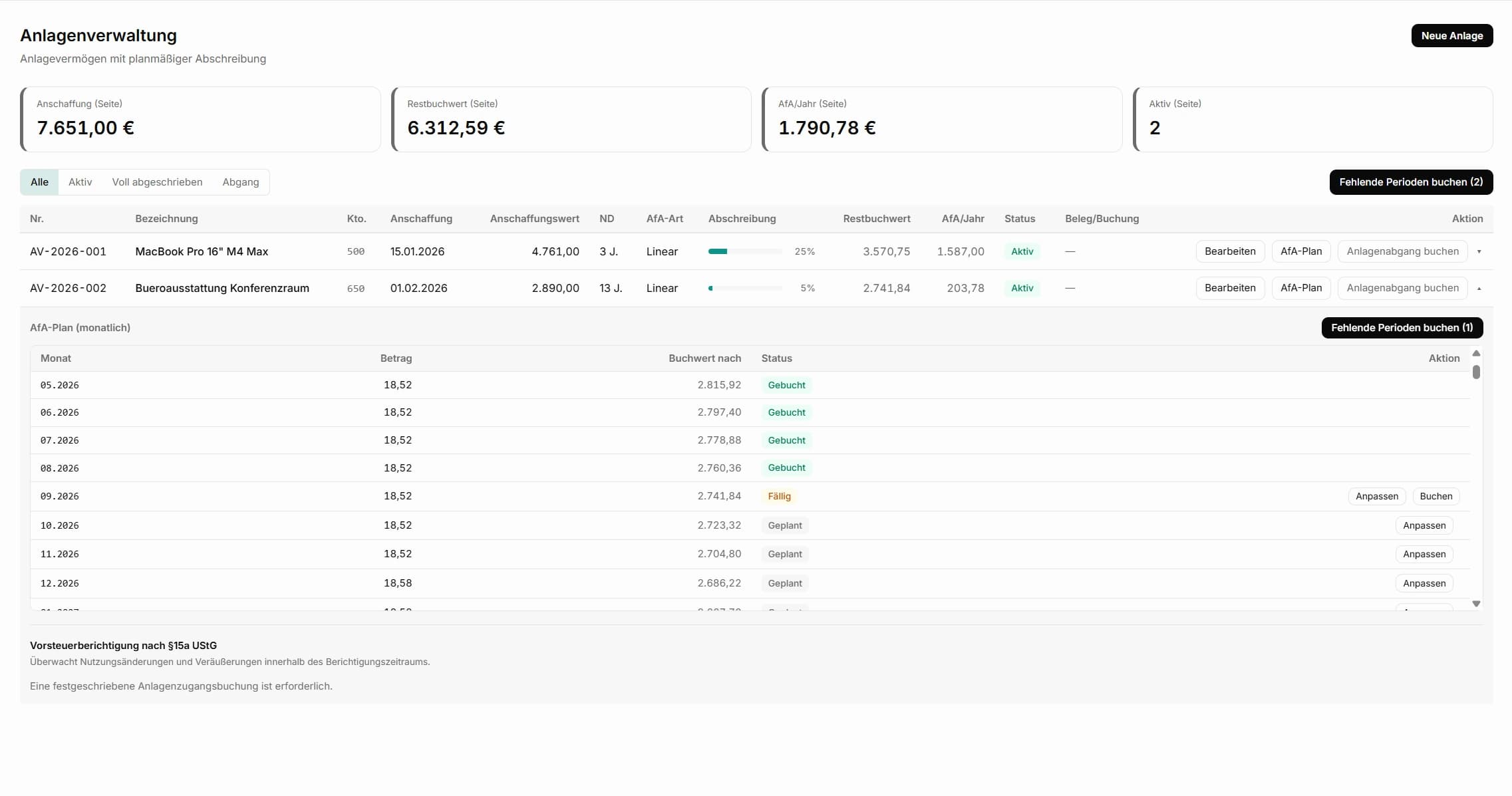
accuno can support the subsequent accounting through fixed assets, documents and reports. Physical counting and any warehouse-management system remain separate steps. Reconcile their results to the accounting records through a controlled handover.
Sources and further information
Related workflows in accuno
These product pages show how accuno supports the workflows described in this guide.
Sources and further information
- Section 240 HGB: opening and annual inventories
- Section 242 HGB: balance sheet and annual accounts
- Section 241a HGB: exemption for qualifying sole traders
- Section 4 EStG: profit, withdrawals and contributions
- Section 141 AO: tax accounting obligations and commencement
- Section 241 HGB: permitted inventory simplifications
- Section 239 HGB: traceable accounting records
- Section 147 AO: retention and access to data
- Section 257 HGB: commercial record retention periods
Editorial note
Prepared by the accuno Editorial Team and reviewed against the listed primary sources and the implemented product scope.
These articles provide general guidance and do not replace legal, tax, or business advice. Confirm your specific situation with a qualified professional.