Accounting for trades: reconcile progress payments and the final invoice
Materials, work and payments follow different schedules. A clear job record prevents missing progress payments and duplicate outstanding balances.
Quick answer
For each job, track completed work, issued invoices and cash actually received separately. A final invoice must correctly account for received progress payments and their VAT components. Reconcile the amount still payable with outstanding receivables before closing the job.
Key takeaways
- An issued progress invoice is not a received payment or automatically a separate partial supply for German VAT.
- A final invoice needs reconciliation with evidence of work, earlier invoices and actual payments.
- A complete handover connects job records, accounting documents, bank transactions and the remaining balance.
Work happens on site; the office needs a reliable record
On a job lasting several weeks, purchasing materials, performing work and invoicing rarely happen together. Installation is partly complete, another delivery is expected and the first progress invoice remains unpaid. An invoice total cannot tell you whether an amount relates to completed work, has been billed or has actually reached the bank. Those questions require separate records.
German Civil Code section 632a links a progress-payment claim to the value of contractually owed work already performed. A schedule must make that work assessable, and non-conforming work can restrict the claim. An arbitrary percentage does not replace evidence of performance.
Our practical recommendation is to keep one clear job reference from the accepted quotation to the last payment. Connect the agreed scope, approved variations and evidence of work. Assign responsibility for confirming progress, preparing the billing documents and checking money received.
Sources and further information
Distinguish advance payments, progress payments and partial supplies
An agreed advance before work starts has a different basis from a progress payment for work already performed. A partial supply for German VAT has its own conditions, including separately agreed consideration for an economically divisible part of the supply. Calling a document a progress invoice does not settle that classification.
Payment due dates also need review. Under section 641 BGB, payment for a work contract is generally linked to acceptance. For construction contracts, section 650g BGB additionally addresses a verifiable final invoice. Check the contract and the relevant circumstances before chasing payment. A date entered into invoicing software does not establish the legal position.
Define which evidence triggers each billing step, such as an approved progress statement or documented acceptance. Keep unresolved questions and agreed retentions alongside the job. Accounting can then distinguish a disputed payment, an amount not yet due and an overdue receivable.
Worked example: the balance after two paid progress invoices
This simplified example assumes completed work of EUR 20,000 net, with 19 percent VAT throughout. Reverse charge, discounts, retentions and other special cases are excluded. Two progress invoices of EUR 5,000 net plus EUR 950 VAT each were paid in full before completion. The table reconciles amounts; it is not a complete invoice template.
Under the conditions in section 14(5) UStG, a final invoice must deduct advance consideration already received and the corresponding VAT. Actual receipts therefore matter. Connect each credited payment to the earlier invoice and its bank transaction.
| Item | Net | VAT | Gross |
|---|---|---|---|
| Completed work | EUR 20,000.00 | EUR 3,800.00 | EUR 23,800.00 |
| Paid progress invoice 1 | −EUR 5,000.00 | −EUR 950.00 | −EUR 5,950.00 |
| Paid progress invoice 2 | −EUR 5,000.00 | −EUR 950.00 | −EUR 5,950.00 |
| Amount still payable | EUR 10,000.00 | EUR 1,900.00 | EUR 11,900.00 |
Sources and further information
An unpaid progress invoice must not appear as money received
If only the first progress invoice has been paid, receipts total EUR 5,950. With no other changes or retentions, EUR 17,850 remains payable for the completed work. The second invoice must not appear as a received payment in your reconciliation. Agree how its existing receivable is handled when the final invoice enters accounting.
Avoid duplicating the debt: an old outstanding progress invoice must not remain in addition to a final-invoice balance that already includes the same amount. Do not delete posted records simply to make the display look right. The transition should remain understandable through its documents and any traceable correcting entries.
A weekly review can cover invoices issued, payments allocated, amounts credited and unresolved differences. Record who is responsible and what happens next in the job overview.
Sources and further information
Review VAT before reaching the final invoice
In an ordinarily taxable German transaction, payment before the supply is performed can already trigger VAT. Section 13 UStG links this to the VAT return period in which payment is received. The actual receipt date and allocation therefore matter while the job is still underway. Do not automatically postpone that review until final billing.
Certain construction services can also make the recipient liable for VAT. Section 13b UStG does not automatically apply to every trades job. Establish the nature of the service, the recipient and the necessary evidence before invoicing. The 19 percent example only illustrates its expressly stated standard case.
Sources and further information
Give accounting a complete handover
Before closing the job, another person should be able to reconstruct it without an oral explanation. The following checklist is a workflow recommendation, not a substitute for reviewing the particular contract. Variations, disputed items and unallocated payments should remain clearly visible as unresolved matters.
- Collect the contract, approved variations and evidence of work.
- Review acceptance records and the basis for payment becoming due.
- Reconcile every progress invoice with actual receipts.
- Check credited net amounts, VAT and the remaining balance.
- Document the transition of existing receivables and any corrections.
- Hand unresolved questions and named owners to accounting or the tax advisor.
Sources and further information
Where accuno supports the accounting workflow
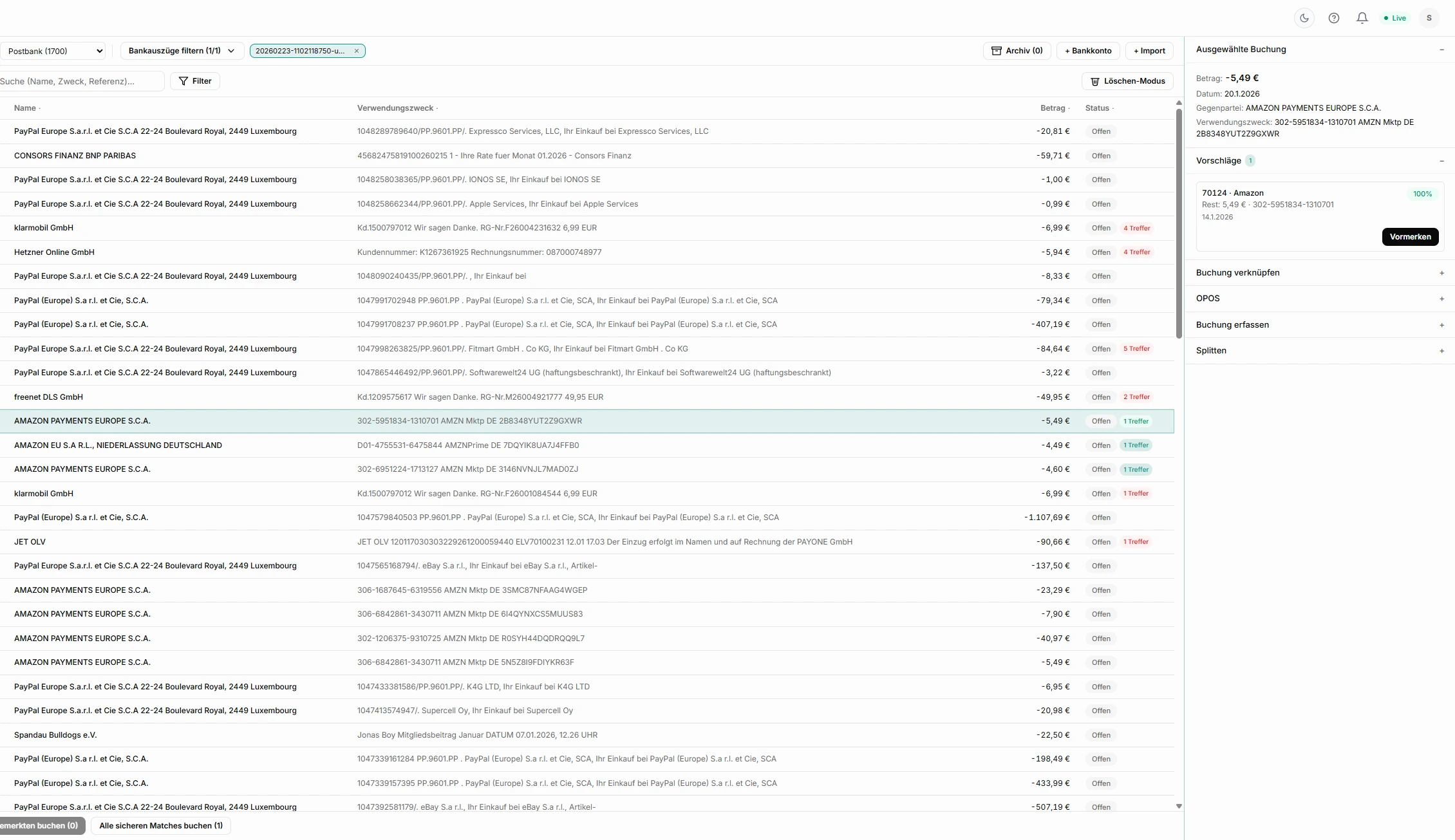
accuno shows customer and supplier open items with due dates and remaining balances. Banking import supports payment allocation, including partial amounts. Check suggested matches against invoice references, business partners and amounts. DATEV export with document references supports handover to the tax advisor.
Confirming work, documenting acceptance and correctly preparing progress or final invoices remain earlier steps. This workflow does not assume automatic construction-contract final invoicing in accuno. Begin with a completed sample job and compare its independently established remaining balance with imported receivables. A reliable overview starts with a consistent chain of documents.
Related workflows in accuno
These product pages show how accuno supports the workflows described in this guide.
Sources and further information
- Section 632a BGB: progress payments and evidence of work
- Section 13 UStG: VAT timing for supplies and advance payments
- Section 641 BGB: when payment for work becomes due
- Section 650g BGB: verifiable final invoices for construction contracts
- Section 14 UStG: invoice information and e-invoices
- Section 239 HGB: traceable accounting records
- Section 13b UStG: recipient liability for VAT
Editorial note
Prepared by the accuno Editorial Team and reviewed against the listed primary sources and the implemented product scope.
These articles provide general guidance and do not replace legal, tax, or business advice. Confirm your specific situation with a qualified professional.