Agency accounting: cost centres, external services and project margins
Which costs belong to design, which to a client project, and what remains from the fee? Clear assignments make the calculation understandable.
Quick answer
A cost centre identifies where costs arise, such as design, sales or administration. A cost object identifies what they relate to, such as a client project. Agencies should track external services, internal time, overheads and payment timing separately to make project margins and cash needs understandable.
Key takeaways
- Project revenue minus freelancer invoices is not a complete measure of project profit.
- Recharged expenditure does not become a disbursement simply because there is no markup.
- A profitable project may require financing when suppliers are paid before the client pays.
A project needs more than a revenue column
An agency wins a website relaunch for EUR 12,000. External design and development cost EUR 3,500, apparently leaving EUR 8,500. That amount must also cover concept work, project management, meetings and revisions. A busy order book alone does not show whether the time tied up in delivery is adequately rewarded.
Start with an estimate of scope, fee, external purchases and internal hours. Specify included revision rounds and who can authorize extra work. Update actual effort and remaining expected costs during delivery. Freelancer work already commissioned belongs in the forecast even before the supplier sends an invoice.
An internal cost rate needs a realistic assessment of available project hours and costs to be covered. Gründerplattform explains this underlying hourly-rate logic. A selling rate is different from an internal cost rate; do not mix the two in one calculation.
Sources and further information
Cost centres explained: where do the costs arise?
A cost type describes what the cost is, such as rent, salaries or software. A cost centre assigns it to an organizational area such as design, development, sales or administration. A cost object is the service or job whose cost you want to establish. A client project is therefore often a cost object rather than a department.
The same distinction works outside agencies: a trades business might use workshop and administration cost centres, while a retailer might use branches. The structure is a management choice. Make responsibilities visible while keeping it simple enough to maintain reliably.
Sources and further information
Examples and a simple overhead allocation
The table is our own organizational example. Assume monthly shared rent of €1,200: design occupies 60 square metres, development 30 and administration 30. Allocating by floor area gives €600, €300 and €300 respectively. The total remains €1,200.
Floor area may suit occupancy costs but not every software subscription or project. Assign directly attributable costs directly where possible. Keep allocation drivers understandable and review them when usage changes. Avoid charging a cost already allocated to a project a second time in full.
| Cost centre | Typical costs | Possible cost object |
|---|---|---|
| Design | Design software, team salaries | Client A brand project |
| Development | Development tools, team salaries | Client B website |
| Administration | Office organization, general administration | Overheads supporting multiple jobs |
Sources and further information
Worked example: another revision round changes the margin
Our own simplified planning example uses net figures and assumes full input VAT recovery. It allocates EUR 55 of internal cost to each of 100 project hours. Here, that assumed rate includes the allocated staff costs and overheads; those same costs must not then be deducted again in full. EUR 55 is not a recommended market price for agency work.
The estimated project surplus is EUR 3,000, or 25 percent of the fee. If delivery requires another 20 hours at the same fee, internal costs increase by EUR 1,100. The remaining surplus is EUR 1,900, approximately 15.8 percent. This calculation highlights the effect of additional work. It is neither taxable profit nor evidence of available cash.
| Item | Original plan | With 20 extra hours |
|---|---|---|
| Net fee | EUR 12,000.00 | EUR 12,000.00 |
| External costs | −EUR 3,500.00 | −EUR 3,500.00 |
| Internal costs at EUR 55/hour | −EUR 5,500.00 | −EUR 6,600.00 |
| Estimated project surplus | EUR 3,000.00 | EUR 1,900.00 |
| Share of net fee | 25.0% | 15.8% |
Sources and further information
An external purchase or a disbursement?
An agency hires a photographer in its own name and recharges the client. Having no markup does not by itself make this a disbursement. The exception in German VAT Act section 10 requires amounts to be received and spent in another party’s name and for that party’s account. The contract, invoice addressee and actual arrangement matter.
Resolve this before accounting for media budgets, licences or production costs. Record who contracted with the supplier and who received the supplier’s invoice. An internal label such as “client expense” is not sufficient evidence. Agree consistent treatment with accounting and resolve special cases before recharging them.
Regardless of that classification, the project overview should connect each external order with a client project, an approved amount and the work actually delivered. Treat the overview as a working document. Tax treatment must follow the underlying agreements and evidence.
Sources and further information
Project costing and financial accounting answer different questions
A project estimate can include expected hours, supplier invoices not yet received and possible extra work. Those assumptions are not transactions already posted in accounting. Keep separate columns for the plan, committed costs, actual costs and remaining expectations. An approved additional budget should remain identifiable while it has not yet been invoiced.
For businesses preparing German commercial-law financial statements, section 252 HGB includes accrual and realization principles. Forecast revenue or a percentage-complete estimate does not replace the accounting assessment. Businesses using an Einnahmenüberschussrechnung, the German cash-basis profit calculation, follow different underlying rules; do not automatically apply balance-sheet statements to them.
At month end, discuss projects whose work, invoices and costs fall into different periods. Project management supplies the operational facts; accounting assesses their treatment. A documented reconciliation then explains why the project overview and management accounts do not show the same figure.
Sources and further information
Profitable does not mean cash is available today
External production may become payable before a client approval allows you to issue your own invoice. Plan dated cash receipts and payments alongside the margin calculation. Cash planning uses payment amounts including relevant taxes. It also includes business-wide payments that cannot sensibly be attributed to one particular job.
Flag uncertain approvals and delayed client payments. We recommend reviewing upcoming dates each week: which invoice needs issuing, which is outstanding and which supplier payment comes first? An agreed advance or milestone payment can change the timing, but it must fit the contract and billing arrangement.
Sources and further information
A short monthly routine for project management and accounting
Use a shared list with a common cutoff date instead of several incompatible project snapshots. Our checklist focuses on the handover from operational delivery to accounting. Record assumptions and corrections so that the previous position can still be reconstructed during the next review.
- Reconcile fees and approved additional work with the client agreement.
- Review external orders, invoices received and costs still expected.
- Update actual hours and the effort needed to finish.
- Assess recharged costs and possible disbursements separately.
- Reconcile client receivables, supplier liabilities and payment dates.
- Document deviations from plan, their causes, decisions and owners.
Sources and further information
accuno’s role in agency accounting
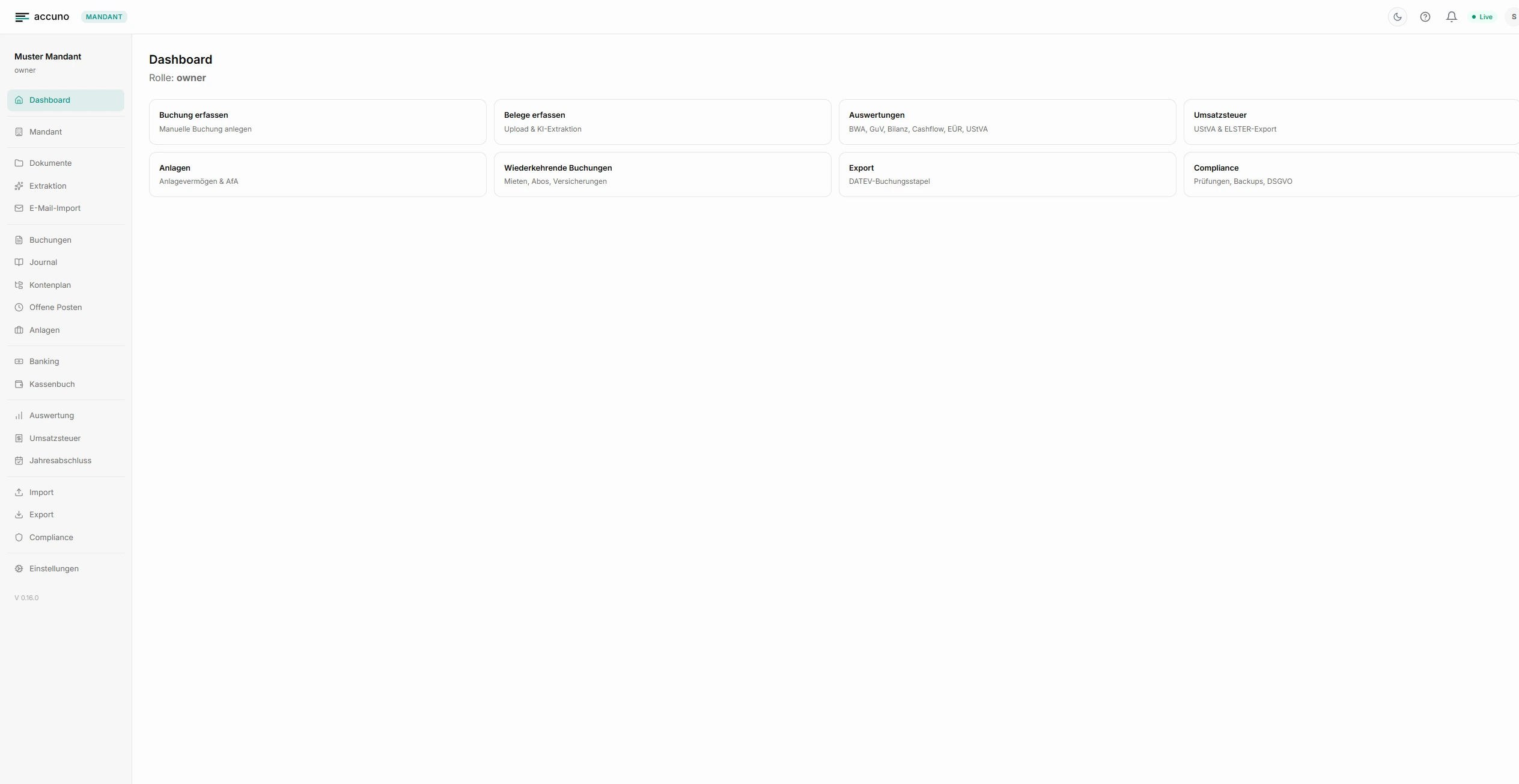
accuno supports capturing and reviewing incoming documents, monitoring customer and supplier open items, and reporting on posted accounting data. Accounting can check which freelancer invoice has been recorded, which client has not paid and which amounts have reached the financial records.
Maintain the project costing described here in your existing project or time-planning process and reconcile it with accounting. This workflow does not assume integrated time tracking or automatic project-margin calculation in accuno. Start with one completed job and compare its original estimate, actual hours, supplier documents and payments. Explained differences provide better assumptions for the next quotation.
Related workflows in accuno
These product pages show how accuno supports the workflows described in this guide.
Sources and further information
- Gründerplattform: calculating working time, costs and hourly rates
- Section 10 UStG: consideration and disbursements
- Section 252 HGB: realization and accrual accounting
- Gründerplattform: planning the timing of cash inflows and outflows
- Section 239 HGB: traceable accounting records
- GründerZeiten 23: cost types, cost centres and cost objects (page 5)
Editorial note
Prepared by the accuno Editorial Team and reviewed against the listed primary sources and the implemented product scope.
These articles provide general guidance and do not replace legal, tax, or business advice. Confirm your specific situation with a qualified professional.