3 reasons why AI will not fully replace accounting
AI will transform large parts of accounting. The system of record, traceable controls, and deliberate human decisions will remain essential.
Quick answer
AI will automate accounting deeply, but it will not replace it completely: agents still require a reliable accounting system, automated workflows need traceable controls and accountable ownership, and compute-intensive models create the most value when used selectively for ambiguous work.
Key takeaways
- Even AI that operates software independently needs a reliable system for data, rules, permissions, and postings.
- German GoBD principles do not prohibit automation, but they require traceable processes, controls, protected records, and reviewable corrections.
- The strongest unit economics use powerful models for uncertainty and exceptions, not for every deterministic system action.
The real question is not human or AI
The debate about AI in accounting is often framed as a binary choice: either people do the work, or an increasingly capable model eventually takes over the entire process. That framing is too narrow. Accounting is not merely a sequence of actions on a screen. It is also a system of records, rules, controls, evidence, and decisions with legal and economic consequences.
The discussion around powerful agentic models makes the question more urgent. Even if a model can operate a computer independently and perform complex work across several applications, that does not make the underlying accounting software disappear. What matters is which tasks a model can perform reliably and which infrastructure makes that work safe, reviewable, and useful. The following assessment is our architectural thesis, not a prediction of a guaranteed technical development.
AI is therefore likely to prepare more accounting work and, in bounded cases, execute it. It does not remove the system of record or organizational accountability. The strongest solution is not an artificial accountant without an operating environment. It is the combination of an accounting platform, targeted AI, and risk-based control.
Sources and further information
Reason 1: Even the most intelligent AI needs accounting software
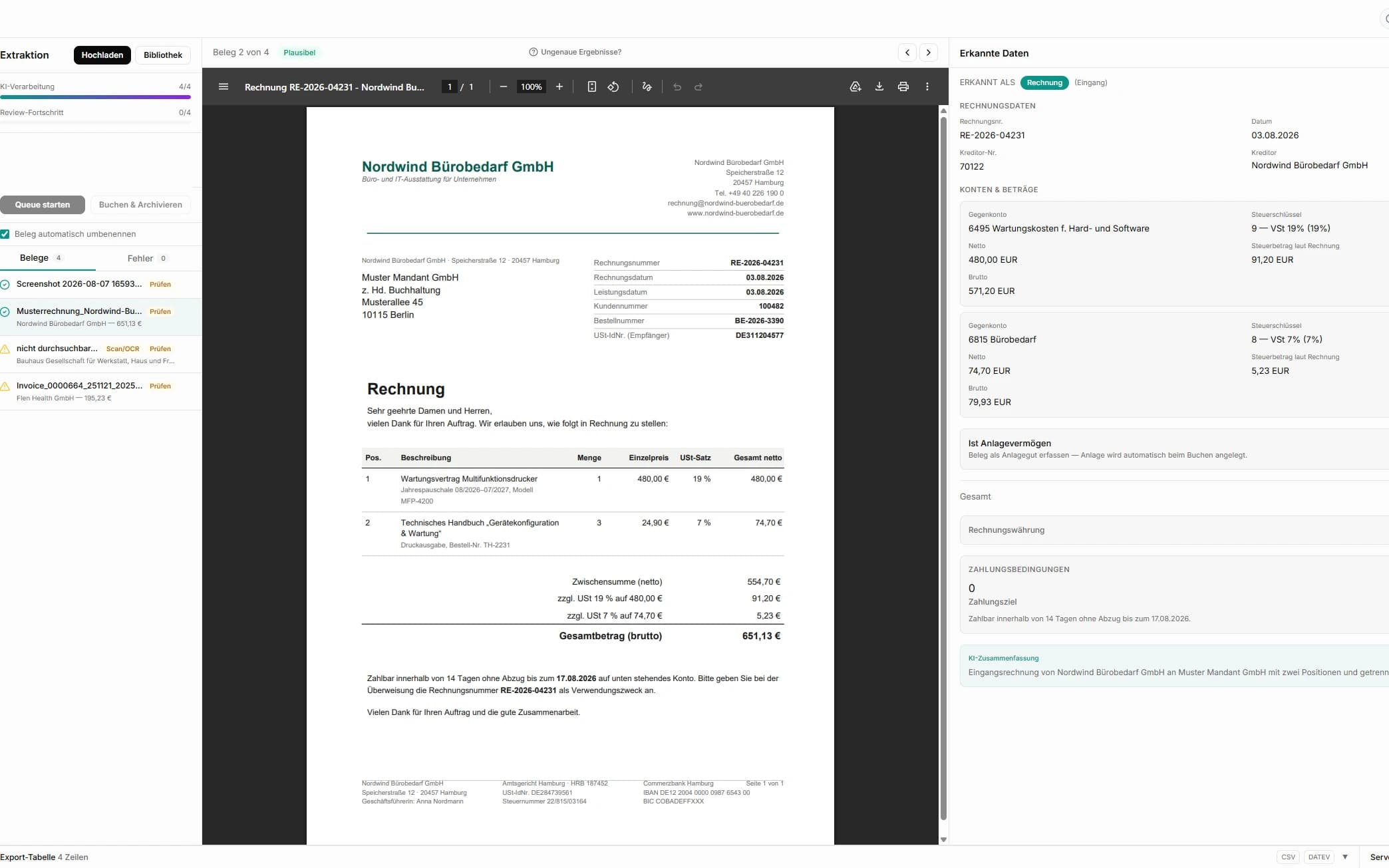
An agent can open an invoice, recognize data, search for an account, and operate a posting form. In doing so, it performs work inside software. It does not automatically replace the capabilities that software provides: a consistent chart of accounts, posting periods, record references, tax logic, debits and credits, open items, permissions, posting locks, reversal workflows, exports, and reports.
The distinction can be described as two layers. AI is a decision and interaction layer. It interprets unstructured information, evaluates candidates, and proposes the next useful step. The accounting platform is the execution and evidence layer. It enforces data structures, checks invariants, manages state, and records what actually happened. A model can suggest a posting. Only the system ensures that it is written once, in an open period, with balanced amounts and the required references.
The more autonomously an agent works, the more important this technical foundation becomes. People often notice from a screen that a record is locked, a period is closed, or the wrong client is open. An agent needs machine-readable state, unambiguous interfaces, and hard permission boundaries. Better AI therefore does not make good accounting software less relevant. It changes that software from an interface for people into a controlled work environment for both people and agents.
- The ledger remains the authoritative data source, not a model conversation.
- The system enforces permissions and client isolation instead of relying on prompt instructions.
- Posting rules, period locks, and idempotency apply regardless of who initiates an action.
- Every suggestion remains connected to its source record, decision, approval, and resulting report.
Sources and further information
Reason 2: Automation still needs controls aligned with German record-keeping principles
The German GoBD principles do not prohibit automation. A blanket statement that fully automated processing is always impermissible would therefore be wrong. The requirements do, however, shift the focus from speed alone to control over the procedure. Business transactions must remain traceable and reviewable. Changes, corrections, access, and processing steps need a robust relationship with the original record and the accounting data that was actually maintained.
An autonomous model that makes decisions only in a transient conversation and writes results into the ledger without a controlled process does not provide that foundation. Businesses need documented procedures, appropriate controls, defined responsibilities, and a reproducible correction path. For finalized postings, correction should not mean an invisible overwrite. It should mean a traceable reversal followed by a new, properly supported posting.
Human control does not necessarily mean clicking on every standard posting. A risk-based approach can largely automate known, low-value cases that pass clear technical checks. Unusual tax circumstances, new counterparties, contradictory invoice data, high amounts, or changes to master data can be escalated to qualified people. The important point is that the control design is deliberate, technically enforced, and reviewable later.
Accountability remains even if a model reaches a high level of accuracy. Management, accounting owners, and qualified tax professionals where appropriate must define the applicable rules and how exceptions are handled. AI can improve the information available for a decision. It cannot decide by itself which risk a business is authorized to accept without approval.
Sources and further information
Reason 3: Powerful models should not spend tokens on every action
Powerful models consume compute for every request. They process input tokens, generate output tokens, and often require several steps in an agentic workflow. If an agent opens a form, retrieves an account catalogue, reviews a record, and then corrects a field, context and tool results may be transmitted and processed repeatedly. A seemingly small task becomes a chain of inference steps with cost and latency.
Many accounting actions do not require that kind of intelligence. A debit and credit total can be checked deterministically. A closed period can be blocked by a database rule. An invoice number that has already been imported can be detected locally. For those tasks, conventional application code is cheaper, faster, reproducible, and easier to test than another model call.
AI creates the most value where language, document layout, conflicting evidence, or business context must be interpreted. It can evaluate a small relevant set from thousands of possible accounts, structure an unfamiliar invoice, or explain an ambiguous transaction for review. The deterministic core then takes over again: validating amounts, checking permissions, storing the posting, extending the log, and updating reports.
This principle remains economically useful even as model prices decline. A repeatable calculation is almost always cheaper than a fresh probabilistic judgment. Targeted AI therefore improves more than gross margin. It reduces latency, possible error modes, and the amount of sensitive information that a model needs to see for the task.
RouteLLM studies a related research question: how can requests be routed between stronger and less expensive language models? The paper reports cost improvements on the benchmarks it evaluates. It establishes neither a specific saving in accuno nor the replacement of a model with posting rules. Our recommendation to keep deterministic work in the application core is a further engineering judgment.
Sources and further information
The target architecture: deterministic core, AI judgment, and a control layer
A future-ready accounting platform separates three jobs. The deterministic core manages master data, accounts, records, postings, taxes, periods, payments, and reports. The AI layer interprets information and exercises judgment where fixed rules reach their limits. The control layer uses risk, amount, confidence, and business context to decide whether a transaction may continue automatically or requires review.
This architecture uses the strengths of each approach. Rules provide speed and guaranteed properties. AI provides flexibility for unfamiliar or linguistically complex cases. People remain accountable for material decisions, edge cases, and the control system itself. No layer has to pretend that it can manage the entire accounting process alone.
- Deterministic: totals, required fields, duplicates, periods, permissions, and posting invariants.
- AI-assisted: document understanding, counterparty resolution, account candidates, and explanations for ambiguous cases.
- Risk-based: automatic processing for known cases and visible escalation for material exceptions.
- Human-owned: rules, materiality thresholds, special cases, close, and professional approvals.
Sources and further information
What AI is likely to automate extensively
Saying that AI will not replace accounting completely is not an argument against ambitious automation. Invoice extraction, document classification, master-data matching, account suggestions, payment matching, anomaly detection, and the preparation of recurring close tasks can become substantially faster. With useful historical evidence, the system can prioritize known patterns and focus review on deviations.
Interaction with software will also move into the background. Users do not need to open every form forever if an agent can perform the same steps through secure tools. The interface still matters as the place for transparency, exception handling, approvals, and a clear view of system state. Less manual interaction does not mean less software. It means different software.
What remains a responsibility and a system capability
Authoritative data storage, the definition of account and tax context, protection against impermissible changes, reconciliation between subledgers and the general ledger, and the decision that a period is professionally complete all remain necessary. Decisions that combine a document, contract, economic substance, and tax interpretation also remain especially control-sensitive.
Tax advisors and accounting professionals do not become irrelevant. Their work shifts from repetitive data entry toward process design, plausibility review, exception decisions, and advice. Businesses benefit most when software supports this collaboration with shared data, clear roles, and traceable questions instead of disconnected exports and email loops.
Sources and further information
What this thesis means for accuno
accuno is therefore not building an isolated AI that merely imitates accounting. The platform connects documents, accounts, postings, banking, open items, taxes, and reports within one client context. AI makes unstructured information usable, evaluates relevant candidates, and prepares routine work. The application core validates and records the effect. People confirm results where risk or professional significance requires it.
This is neither a retreat from powerful AI nor a defence of unnecessary manual work. It is the foundation for using stronger models productively. As agents improve, more tasks can be delegated to them under control. At the same time, the value of a platform that provides correct data, safe tools, and clear boundaries grows.
Accounting of the future will therefore be far more automated than it is today. It will still consist of software, controls, and accountable decisions. AI replaces individual activities, changes roles, and accelerates the process. The system supporting the numbers remains.
Related workflows in accuno
These product pages show how accuno supports the workflows described in this guide.
Sources and further information
Editorial note
Prepared by the accuno Editorial Team and reviewed against the listed primary sources and the implemented product scope.
These articles provide general guidance and do not replace legal, tax, or business advice. Confirm your specific situation with a qualified professional.